Interview nerves can show up as a racing mind, a shaky voice, blanking on examples, or replaying every sentence the moment it leaves your mouth. The goal isn’t to “feel fearless.” It’s to create a calm, repeatable routine so confidence feels less like luck and more like preparation. Below is a simple pre-interview toolkit—breathing, grounding, mindset cues, quick practice drills, and an hour-before plan—so your skills and experience come through clearly.
Interviews combine pressure with uncertainty, which can trigger a stress response: faster heartbeat, shallow breathing, and narrowed attention. When your attention narrows, recall can feel harder—like your brain suddenly “lost” stories you’ve told a hundred times. That’s not a character flaw; it’s a predictable body reaction to stress.
Stress also tends to magnify stakes. A small stumble can feel like a major failure, and the mind fills in worst-case outcomes. Reframing helps: rather than “I’m being judged,” treat it as “I’m gathering information while showing how I work.” The conversation becomes more usable and less threatening.
Many people notice nerves spike right before starting—especially the first 60–120 seconds. Planning for that window prevents early momentum loss. Calm isn’t the absence of nerves; it’s the ability to act effectively while they’re present. For a quick overview of how stress affects the body, see the American Psychological Association’s summary.
Inhale through your nose, then exhale longer through your mouth. A longer exhale signals “downshift,” which can slow your speech and reduce that tight, rushed feeling. If you want a structured approach, the NHS breathing exercises guide is simple and practical.
Do a quick 5-4-3-2-1 scan: name 5 things you see, 4 you feel, 3 you hear, 2 you smell, 1 you taste. It interrupts spiraling thoughts by returning attention to the present environment.
Feet flat. Shoulders down. Jaw unclenched. Relaxed posture can soften physiological stress. If you’re on video, it also reads as steady, even when you feel activated.
Skip forced positivity. Use a neutral, believable line that nudges you into process: “One question at a time,” “Slow is smooth,” or “Clarify, then answer.”
Use STAR (Situation, Task, Action, Result) or CAR (Challenge, Action, Result). Structure reduces rambling and gives you a reliable way to restart if you lose your place mid-answer.
Prepare five role-relevant stories: a win, a challenge, a conflict, a learning moment, and an impact story (with metrics if possible). Add three thoughtful questions for the interviewer, such as what success looks like in 90 days or what the team’s biggest bottleneck is right now.
Skim the job description and map three strengths to three needs. Keep it tight—deep research rabbit holes often increase anxiety without improving performance. Your goal is clarity, not overwhelm.
Do the breathing reset and grounding, then set camera/lighting, remove visual distractions, and keep water nearby. If you’re interviewing remotely, reliable audio reduces cognitive load; a simple wired option can help you sound clear without fiddling with Bluetooth pairing. Consider 3.5mm/Type-C Wired Gaming Earbuds with Mic & Detachable Cable for a plug-and-go setup.
| Moment | What it feels like | Fast reset | What to say next |
|---|---|---|---|
| Brain goes blank | Thoughts stop, panic rises | Long exhale + look at notes | “Let me take a second to organize that—here’s the example that best fits.” |
| Racing speech | Words tumble, breath is shallow | Pause + sip of water | “I’ll slow down and walk through it step by step.” |
| Tough question | Fear of being wrong | Clarify the question | “To make sure I answer well, are you asking about X or Y?” |
| Stumble or mistake | Embarrassment spike | Name it briefly + move on | “Good catch—what I mean is…” |
| Panel or rapid-fire | Overwhelm, scattered attention | Pick one person to start, then scan | “I’ll start with the main point, then add an example.” |
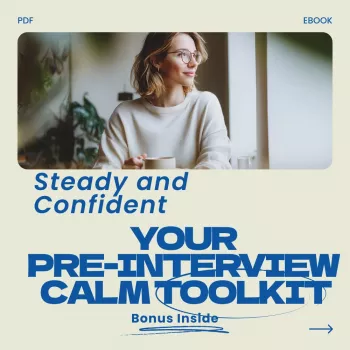
If you want a single, repeatable routine you can use across phone screens, video calls, and final rounds, Steady and Confident: Your Pre-Interview Calm Toolkit (Digital Download) is designed to reduce job interview anxiety and help you show up with clearer presence.
Use a 3–5 minute sequence: longer-exhale breathing, the 5-4-3-2-1 grounding scan, a posture reset (feet flat, shoulders down, jaw relaxed), then a one-line process cue like “One question at a time.” Start by slowing your first sentence to set the pace.
Rely on structure: STAR or CAR, plus a short list of five story bullets you can glance at. If you blank, pause and exhale, summarize what you’ve already said in one line, then add one concrete example to restart momentum.
Focus on controllables: speak slightly slower for the first two minutes, use intentional pauses, and lead with outcomes before details. Ask clarifying questions when needed and end answers with a crisp takeaway sentence.




Leave a comment