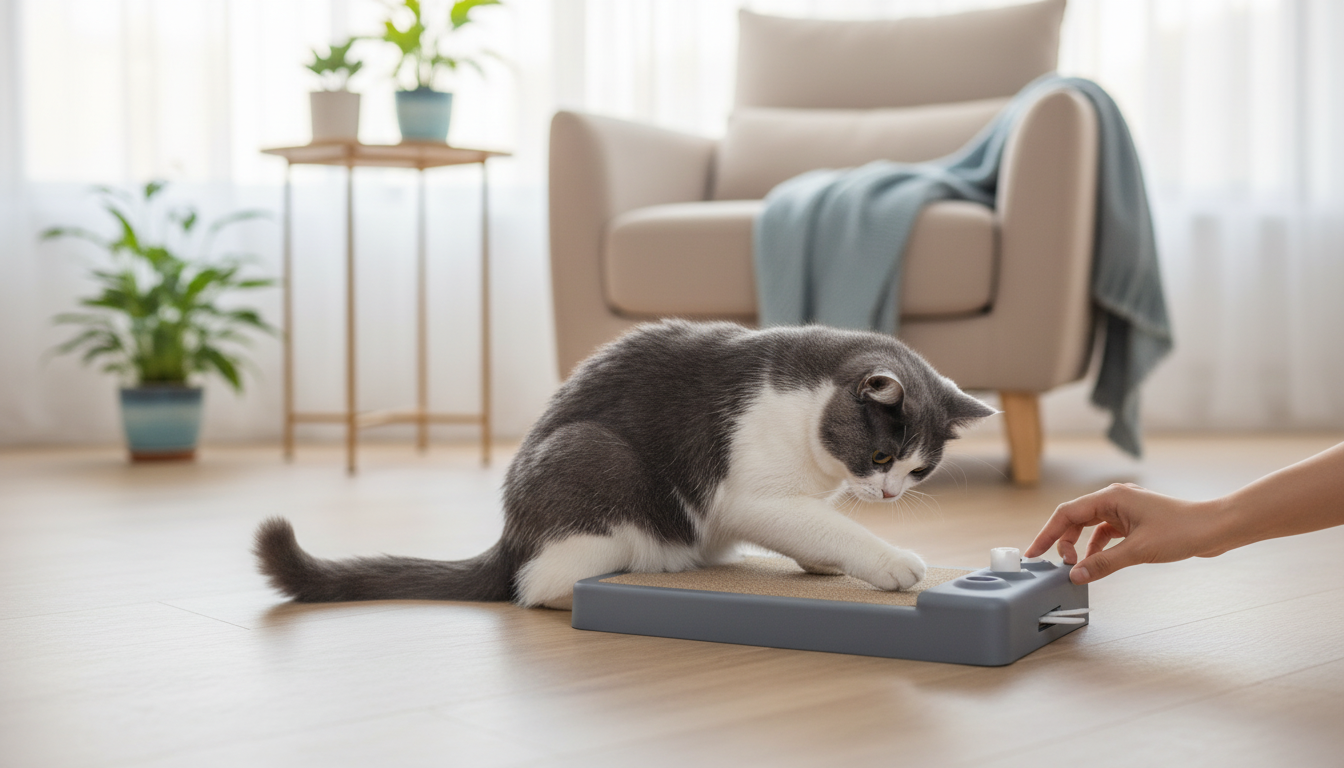
Cats scratch to stretch, shed claw sheaths, and mark territory. A sturdy scratching board gives that instinct a dedicated place, helping redirect scratching away from rugs and furniture while adding an easy enrichment option for indoor cats. If scratching has become a daily “must,” the right board can turn it into a predictable routine that supports healthier claws and a calmer home.
Not all cardboard scratchers feel the same under a cat’s paws. A board that gets used daily needs to hold up to repeated rakes, kneading, and full-body stretches without sliding around or collapsing into soft pulp.
For general scratching guidance and why cats do it in the first place, the ASPCA and Humane Society both offer useful behavior resources: ASPCA cat behavior tips and Humane Society scratching solutions.
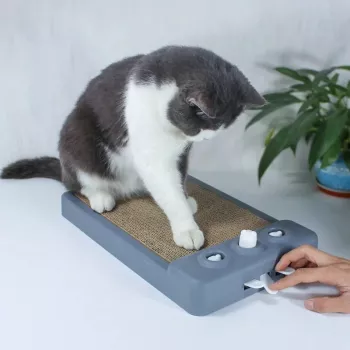
If your cat targets carpets, mats, or area rugs, a horizontal scratch zone is often the fastest “trade” to offer. The Durable Cat Scratching Board is designed to be an easy, daily-use option that fits naturally into a cat’s routine without taking over the room.
| Where to place it | Why it works | Tip to improve success |
|---|---|---|
| Next to the furniture being scratched | Gives an immediate alternative right at the problem spot | Place it within 6–12 inches of the target area for the first week |
| Near sleeping areas | Cats often scratch after waking to stretch and activate muscles | Add a short play session nearby, then reward when the cat uses the board |
| By windows or cat perches | High-traffic observation zones trigger marking and routine scratching | Anchor with a non-slip mat if the floor is slick |
| In entryways or cat “routes” | Cats scratch when transitioning between spaces | Use two boards to create consistent stations on the path |
The smoothest introductions feel “cat-led.” Instead of trying to teach scratching from scratch, set the environment so the board is the easiest, most rewarding place to do what your cat already wants to do.
For broader enrichment ideas that support calmer behavior patterns indoors, Cornell’s feline health resources are a solid reference: Cornell Feline Health Center.
It depends on your cat’s size, how often they scratch, and how many scratch zones you provide. With regular flipping/rotation and stable placement, a board stays useful until it loses resistance or starts shedding layers excessively.
This is usually a placement or stability issue, not “stubbornness.” Move the board closer to the exact scratch spot, prevent sliding with a non-slip pad, consider adding a second board in a preferred zone, and reward any use immediately.
Some cats strongly prefer one style, while others use both. If furniture corners are the main target, adding a vertical option can help, while a horizontal board remains useful for post-nap stretching and rug avoidance.




Leave a comment