HomeBlogBlogDurable Cat Scratching Board: Daily Claw Care & Calm Home

Durable Cat Scratching Board: Daily Claw Care & Calm Home

Durable Cat Scratching Board: Daily Claw Care & Calm Home

Durable Cat Scratching Board for Daily Claw Care and Furniture Protection

Cats scratch to stretch, shed claw sheaths, and mark territory. A sturdy scratching board gives that instinct a dedicated place, helping redirect scratching away from rugs and furniture while adding an easy enrichment option for indoor cats. If scratching has become a daily “must,” the right board can turn it into a predictable routine that supports healthier claws and a calmer home.

What makes a scratching board worth using every day

Not all cardboard scratchers feel the same under a cat’s paws. A board that gets used daily needs to hold up to repeated rakes, kneading, and full-body stretches without sliding around or collapsing into soft pulp.

  • Dense corrugated core: Tighter, thicker corrugation resists flattening and keeps that satisfying resistance under the claws, which is often what cats seek when they scratch.
  • Stable base and balanced shape: A board that stays put encourages longer scratching sessions. If it scoots away mid-stretch, many cats simply return to the couch or rug.
  • Cat-safe materials: Look for boards made with pet-safe adhesives and low-dust construction to reduce loose paper fragments in the surrounding area.
  • Enough surface area for different styles: Some cats do long, straight pulls; others knead; others rake side-to-side. A practical board gives room for all three without forcing awkward posture.
  • Easy to refresh: The best everyday board is simple to flip, rotate, or replace so the “scratch station” stays consistent, even as the surface wears.

For general scratching guidance and why cats do it in the first place, the ASPCA and Humane Society both offer useful behavior resources: ASPCA cat behavior tips and Humane Society scratching solutions.

Durable Cat Scratching Board: highlights and best uses

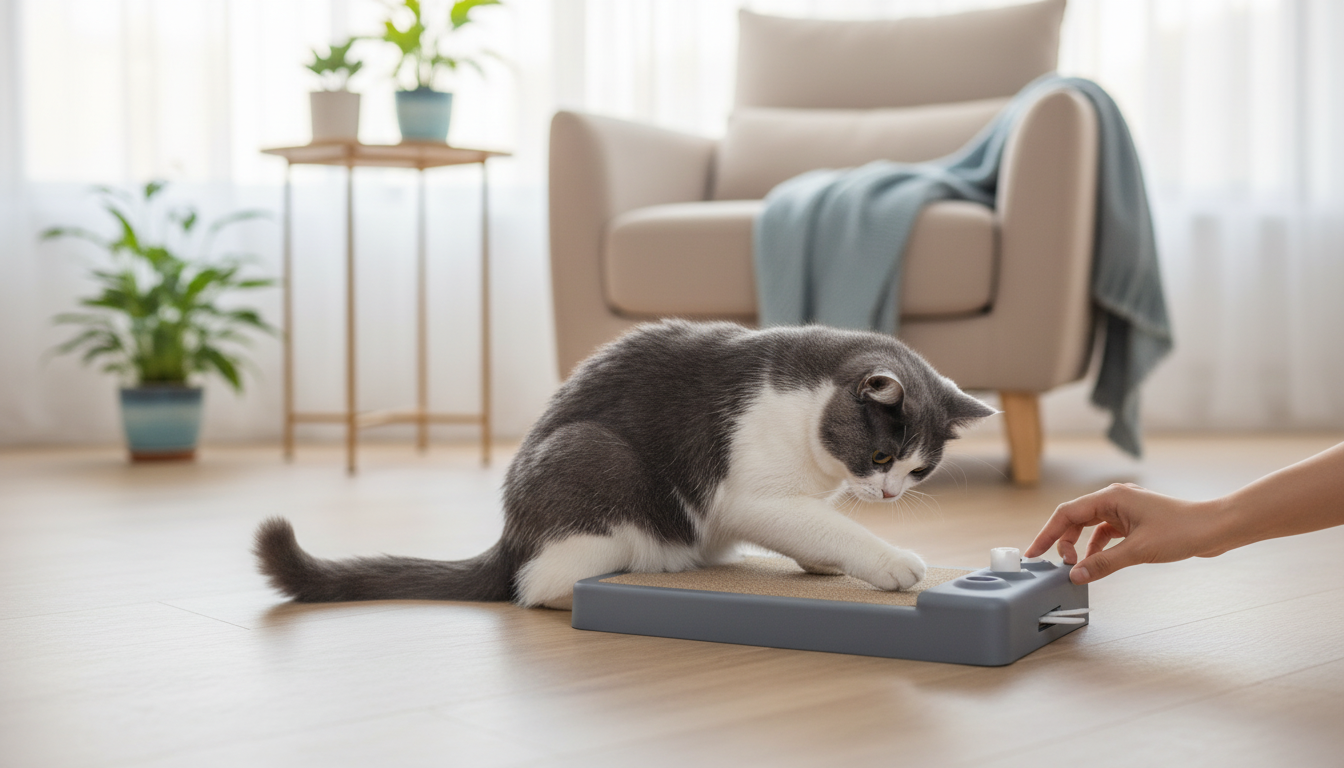
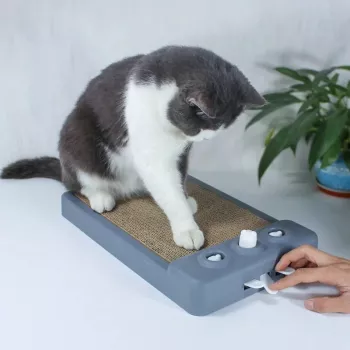
If your cat targets carpets, mats, or area rugs, a horizontal scratch zone is often the fastest “trade” to offer. The Durable Cat Scratching Board is designed to be an easy, daily-use option that fits naturally into a cat’s routine without taking over the room.

  • Everyday scratch zone for horizontal scratchers: Especially helpful for cats that go after carpet edges or rug corners.
  • Great as a “landing spot” near naps: Many cats like to wake up, stretch, and scratch in one sequence.
  • Multi-cat friendly when distributed: Placing one board per key room reduces bottlenecks and helps prevent “resource guarding” behaviors around a single scratcher.
  • Small-space footprint: Easy to move to where your cat already chooses to scratch, which often matters more than where humans want it to go.
  • Pairs well with rewards: Catnip is optional; treats, play, and praise are often more reliable for building the habit quickly.

Quick placement guide for better scratching habits

Where to place it Why it works Tip to improve success
Next to the furniture being scratched Gives an immediate alternative right at the problem spot Place it within 6–12 inches of the target area for the first week
Near sleeping areas Cats often scratch after waking to stretch and activate muscles Add a short play session nearby, then reward when the cat uses the board
By windows or cat perches High-traffic observation zones trigger marking and routine scratching Anchor with a non-slip mat if the floor is slick
In entryways or cat “routes” Cats scratch when transitioning between spaces Use two boards to create consistent stations on the path

How to introduce a scratching board (without forcing it)

The smoothest introductions feel “cat-led.” Instead of trying to teach scratching from scratch, set the environment so the board is the easiest, most rewarding place to do what your cat already wants to do.

For broader enrichment ideas that support calmer behavior patterns indoors, Cornell’s feline health resources are a solid reference: Cornell Feline Health Center.

Keeping the board durable longer

Comfort and routine upgrades that pair well

  • Keep feeding areas calm and ergonomic: A quiet, low-traffic feeding zone can reduce rushed meals and stress-related behaviors that sometimes show up as intense scratching.
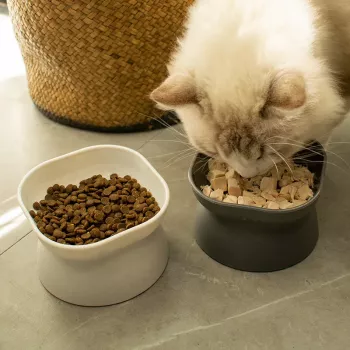
  • Reduce whisker stress and neck strain at mealtimes: A comfortable bowl setup can help some cats settle into a calmer routine. The Stress-Free Tilted Cat Food Bowl is an easy add-on for cats that do better with a more natural eating angle.
  • Link habits together: Many cats love a predictable sequence—eat, then scratch; play, then scratch; wake, then scratch. Consistency makes the board part of “what happens next.”
  • If scratching is stress-driven: Add enrichment alongside the board (short play sessions, window access, and quiet rest zones) instead of relying on a scratcher alone.

FAQ

How long should a scratching board last?

It depends on your cat’s size, how often they scratch, and how many scratch zones you provide. With regular flipping/rotation and stable placement, a board stays useful until it loses resistance or starts shedding layers excessively.

Why does a cat scratch right next to the board instead of on it?

This is usually a placement or stability issue, not “stubbornness.” Move the board closer to the exact scratch spot, prevent sliding with a non-slip pad, consider adding a second board in a preferred zone, and reward any use immediately.

Is a horizontal scratching board enough, or is a vertical scratcher also needed?

Some cats strongly prefer one style, while others use both. If furniture corners are the main target, adding a vertical option can help, while a horizontal board remains useful for post-nap stretching and rug avoidance.

Was this article helpful?

Yes No
Leave a comment
Top

Shopping cart

×