Anxiety can spike in the middle of normal life—during commutes, meetings, parenting moments, or late-night scrolling. Mindfulness offers small, practical skills that help the nervous system settle without requiring perfect silence or long sessions. The exercises below are designed to be done in real-world conditions: noisy rooms, racing thoughts, and limited time.
Anxiety isn’t just “in your head.” It often shows up as a full-body alarm: a tight chest, shallow breathing, clenched jaw, restless legs, nausea, racing thoughts, irritability, and a constant sense of urgency.
Underneath those sensations is a threat-response system that pushes attention into the future—what might go wrong, what could happen next, what needs fixing right now. Mindfulness trains attention to return to present-moment cues of safety: the floor under your feet, the air moving out of your lungs, the fact that you’re in a room rather than the imagined scenario in your mind.
The aim isn’t to eliminate thoughts. It’s to change your relationship to them—less grip, more choice. A practical sign of progress is often subtle: shorter anxiety episodes, quicker recovery, and fewer spirals after triggers. For background on anxiety disorders and common symptoms, see the National Institute of Mental Health.
This is a fast “come back to now” routine for moments when anxiety ramps up.
| Time | Exercise | Best for | How to do it |
|---|---|---|---|
| 30 seconds | Long exhale | Racing thoughts | Inhale gently through nose, then exhale slowly as if fogging a mirror, making the exhale longer than the inhale. |
| 1 minute | 5-4-3-2-1 senses | Panic sensations | Name 5 things you see, 4 you feel, 3 you hear, 2 you smell, 1 you taste (or imagine). |
| 2 minutes | Hand-to-heart breathing | Chest tightness | One hand on chest, one on belly; breathe into the lower hand and soften the upper hand on each exhale. |
| 3 minutes | Labeling thoughts | Rumination | Silently note “planning,” “judging,” “remembering,” then return to one physical sensation (feet, breath, hands). |
| 5 minutes | Body scan (mini) | Tension build-up | Move attention from forehead to jaw to shoulders to hands to belly to feet; relax one area per exhale. |
Breathwork can be calming—but for some people, “slow breathing” can feel activating, dizzying, or even panic-inducing. If that happens, shift from strict counts to gentler cues: “easy inhale, longer exhale.”
For a deeper look at how stress affects the body, the American Psychological Association offers a helpful overview.
Intrusive thoughts can feel like commands or warnings. Mindfulness helps turn down their authority.
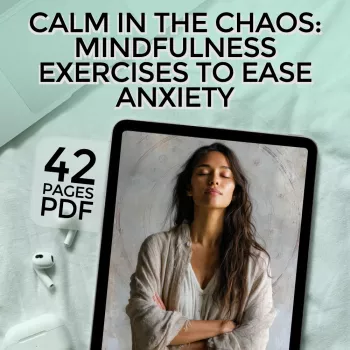
If you like having a ready-made set of prompts, Calm in the Chaos: Mindfulness Exercises to Ease Anxiety is a practical option to keep routines simple and repeatable.
For evening practice, consider pairing a few minutes of breathing or a mini body scan with a familiar comfort item, like the Sofa Knit Throw Blanket with Tassels, to build a steady association with winding down. If routines are the challenge, a simple organizer can support consistency for wellness habits; the 7 Day Pill Organizer Box can help keep daily essentials in one place.
For a well-known structured approach to mindfulness training, explore Mindfulness-Based Stress Reduction (MBSR).
Aim for short daily practice (about 1–5 minutes) and use the same skills “in the moment” during anxiety spikes. Consistency matters more than duration; even a minimum baseline of two mindful breaths per day helps build the habit.
Switch to grounding through senses, touch, or external orientation (naming objects, feeling feet on the floor). If you use breathing, keep it gentle—an easy inhale with a longer exhale—and stop or modify the exercise if symptoms increase.
It may not instantly stop a panic attack, but it can reduce escalation and shorten recovery by bringing attention back to present safety cues. Try a simple plan: ground through senses, extend the exhale, orient to what’s happening right now, then choose one small helpful action; seek professional support if panic is frequent or severe.



Leave a comment